
Bangladesh markets · Part 1 of 3
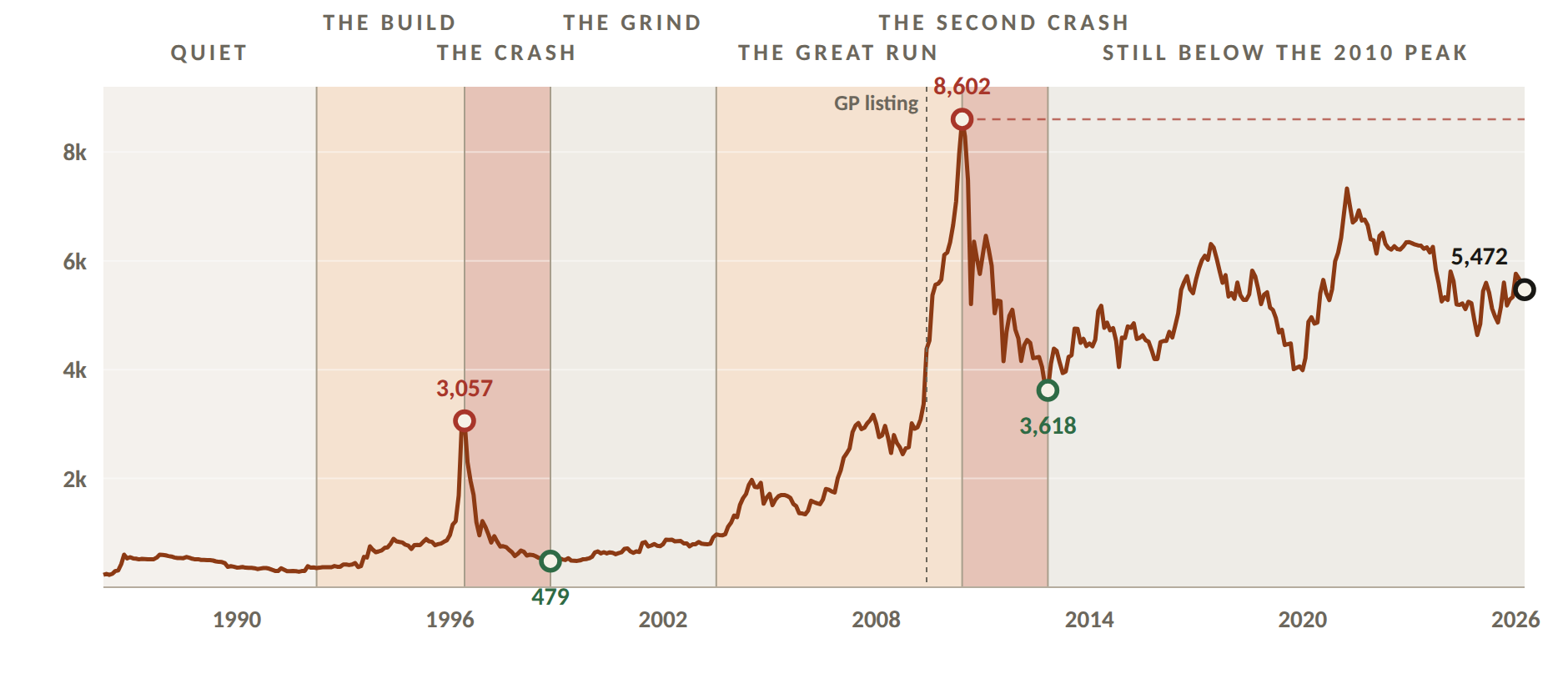
The DSE has collapsed twice: once in 1996, once in 2010. It took eleven years to climb back from the first. Sixteen years after the second, it still has not. Working out why one healed and the other did not tells you more about this market than anything else in its history.
Month-end index. The dashed red line is the 2010 high — the market has been under it ever since.
Tap the chart to open it full size.
Sources: DSE All Share Price Index, DGEN and DSEX, scaled at the joins. The vertical dashed line marks Grameenphone’s listing in November 2009, explained at the end.
The Dhaka Stock Exchange before 1990: a market almost nobody used
The Dhaka exchange opened in 1954 and reopened after independence in 1976 with nine companies listed. By the late 1980s it was still tiny. Traders shouted orders across a floor. When you bought shares, you received a paper certificate. There were almost no banks, funds or insurance companies buying — just a small number of individuals.
The country had bigger problems. Floods in 1988 covered roughly three-quarters of Bangladesh. Cyclone Gorky killed around 138,000 people in April 1991. The country’s foreign currency savings (foreign exchange reserves) fell from $2.70 billion in 1988 to $520 million by 1990 — enough to pay for only a few weeks of imports.
How Bangladesh’s 1990s reforms opened the stock market
In the early 1990s, three things happened together.
Democracy returned with the 1991 election. The Soviet Union collapsed, and money that had been locked up in the Cold War went looking for new places to invest — places people started calling “emerging markets”. And the IMF began lending to Bangladesh, first about SDR 200 million between 1987 and 1990, then roughly SDR 330 million from 1990 to 1993.
IMF loans come with conditions, and those conditions became Bangladeshi law: a VAT system in 1991, a Bank Company Act the same year, a stock market regulator in 1993, and a Companies Act in 1994. Banks were allowed to set their own interest rates. Private companies were allowed to open banks.
Foreign investment in the DSE and the 1996 bubble
Foreign investors started buying, and we know how much. Through a special bank account set up for them (the Non-Resident Investment Taka Account, or NRITA), foreigners put in a net Tk 213.7 crore in 1994. The entire stock market was worth Tk 2,170 crore at the time (its market capitalisation). In one year, foreign money equal to nearly a tenth of the whole market came in. Another Tk 164.8 crore arrived the next year.
At the same time, Bangladesh Bank was printing money faster than it ever had. The money supply (reserve money — the cash the central bank itself creates) grew 32.8 percent in 1993 and 23.9 percent in 1994. This was not a coincidence. When foreign dollars arrive, the central bank buys them so the taka does not get too expensive — and it pays for those dollars with newly created taka. So the same foreign money pushed share prices up twice: once directly, and once by flooding the country with cash.
8.6×
The index went from 354 in September 1992 to 3,057 in November 1996 — more than eight times higher in four years.
The 1996 DSE crash: what caused it and how far it fell
Foreigners began selling before prices peaked. They took out Tk 116 crore in 1996 while the market was still rising.
Then came 1997. They sold Tk 618.7 crore worth of shares and bought only Tk 51.8 crore — twelve times more selling than buying — and sent Tk 633.2 crore out of the country, keeping Tk 274.3 crore in profit. That money leaving in a single year equalled 6 percent of everything the stock market was worth. There were not enough local buyers to absorb it.
The index fell 67 percent in 1997 alone. Then the Asian financial crisis hit in 1997 and 1998, so no foreign money was coming back. Then the 1998 floods, the worst of the century, left two-thirds of the country underwater for months.
Foreigners kept selling every year until 2002. In total Tk 1,067 crore left over seven years, from a market worth between Tk 4,968 and Tk 10,576 crore. Roughly 15 percent of the market’s value walked out the door.
This is why the market did not bounce back. It was not that people felt gloomy. It was that a very large seller was working through the exit, and it took years.
−84%
From 3,057 in November 1996 to 479 in April 1999, in 29 months. That peak was not reached again until April 2008.
After the 1996 crash: seven years at the bottom
Bangladesh Bank responded by making money cheap. Growth in the broader money supply (broad money, or M2 — cash plus everything sitting in bank accounts), which had slowed to 8.2 percent in 1996, was pushed back up to 18.9 percent by 2000. The market bottomed in April 1999 and rallied into late 2000.
Then the world turned again. The dot-com bubble burst from March 2000. 9/11 happened in September 2001. The Iraq war started in March 2003. American interest rates had risen to 6.5 percent, the dollar was strong, and oil was getting expensive.
At home things were as bad as they have ever been. Bad loans (non-performing loans, or NPLs) reached 41 percent of all bank lending in 1999 — meaning four in every ten taka lent out was not being repaid. Money owed to foreign lenders was 30 to 34 percent of the size of the whole economy. Foreign currency reserves bottomed at $1.31 billion in 2001, less than half what they had been in 1995.
The market went sideways for three years. Nobody living through it felt they were looking at an opportunity.
The 2003–2010 bull run in DSE
The recovery started once the damage was repaired — not when prices were lowest. Reserves had rebuilt to $2.47 billion by 2003 (about eighty percent of their old peak). Bad loans were down to 22 percent and still falling. The central bank cut its rate to 5 percent and left it there. Bangladesh was inside an IMF programme for most of this period.
A lot of unglamorous plumbing got fixed at the same time: a floating exchange rate in 2003 (letting the market set the taka’s price rather than the government fixing it), VAT collection that finally worked in 2003 and 2004, and electronic share ownership in 2004 (the Central Depository, or CDBL), which ended paper certificates. The government also learned to borrow for long periods — the first 5-year and 10-year government bonds were sold in June 2006, and 15-year and 20-year bonds in July 2007. For the first time, Bangladesh had a proper structure of interest rates across different lengths of time (a yield curve).
But the real engine was exports. Between 1997 and 2006 they grew 2.4 times, about 10 percent a year, as garment factories multiplied. They ran on cheap government-subsidised gas — so cheap that factories built their own power plants, ran them inefficiently, and still made money. Chevron’s Bibiana gas field opened in March 2007 and kept the supply going.
Some of that export growth was selling more clothes; some was selling them at higher prices. The 2000s were a decade when commodity prices rose worldwide — oil went from $12.70 a barrel in 1999 to $54.40 by 2006 — and garment prices went up too. Bangladesh’s best export decade was not purely a story of Bangladesh winning.
The 2010 DSE crash, and why it was different
The 2008 global financial crisis caused a dip here, but Bangladesh’s actual economy was barely touched. What happened next is the most important decision in the DSE’s recent history, and it usually gets skipped.
With American interest rates at zero, Bangladesh Bank decided to make money very cheap at home — in an economy that had not actually been damaged. The money supply grew 21.6 percent in 2010 and 21.7 percent in 2011, two years above twenty percent in a row. Over four years the amount of money in the country doubled.
Twenty percent money growth is what a country does when it is rebuilding after a disaster. Bangladesh had not had one. So the money went into shares instead: the index rose 90 percent in the eleven months to November 2010. Banks bought shares. Brokers lent people money to buy more shares (margin lending), under rules that were not designed for it.
In December 2010, Bangladesh Bank required banks to hold more cash in reserve (it raised the cash reserve ratio, or CRR), and the whole structure came apart within weeks.
What followed was not a single clean crash. It was years of forced selling, of brokers not collecting on loans when they should have, and of losses being left on the books instead of being admitted. The damage moved out of the stock market and into the banks, and it stayed there.
This is the difference that matters. In 1996, foreigners sold and left; once they had finished, it was over. In 2010, Bangladeshis had borrowed to buy shares, and when prices fell nobody made them settle up. One problem completed itself in seven years. The other has taken sixteen and is still going.
Of the 189 months since January 2011, the market has spent 185 of them more than 20 percent below its own record high.
Part 2 picks up at the 2013 bottom: the recovery, the bank scandals, the war, and what has actually been fixed.
Sources: Dhaka Stock Exchange; Bangladesh Bank (money supply, bank reserves, classified loans); Securities and Exchange Commission annual reports; IMF programme records. General market commentary, not investment advice. What happened before is not a promise about what happens next. Ekush Wealth Management Limited is licensed by the Bangladesh Securities and Exchange Commission.