
Bangladesh markets · Part 3 of 3
Bangladesh Bank swings between making money expensive and making it cheap, on a rhythm that has held for twenty years no matter who is in government. The turn came in mid-2024 — and it is roughly two-thirds finished.
This is Part 3 of a three-part series, after Part 1 on the two crashes and Part 2 on what has been repaired since 2013.
Where to look: the 10-year government bond
When the government borrows for ten years, the rate it has to pay is the clearest measure of what money costs in Bangladesh. That rate only exists because of the bond market built in 2006 and 2007: the first 5-year and 10-year government bonds were sold in June 2006, and 15-year and 20-year bonds in July 2007. Before that the government borrowed short-term and rolled it over, so there was no market price for money beyond a year.
So there are twenty years of record. Long enough to see a rhythm. Not long enough to set your watch by it.
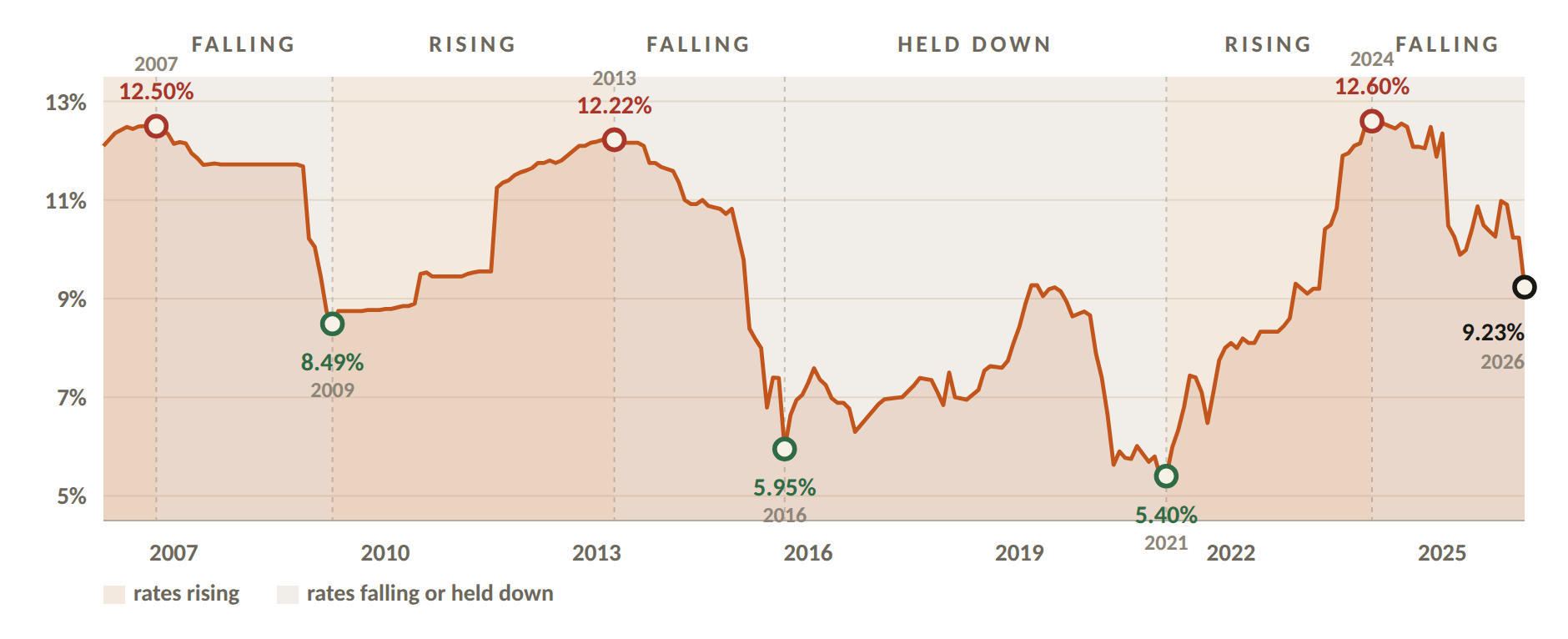
The rate set at each monthly auction, June 2006 to August 2026 — 224 readings. The shading marks each phase of the cycle.
Tap the chart to open it full size.
Source: Bangladesh Bank treasury auction results, 10-year bonds.
The turning points
| Date | Turn | 10-year rate |
|---|---|---|
| June 2006 | first auction | 12.10% |
| March 2007 | peak | 12.50% |
| September 2009 | bottom | 8.49% |
| September 2013 | peak | 12.22% |
| February 2016 | bottom | 5.95% |
| July 2021 | lowest ever | 5.40% |
| June 2024 | peak | 12.60% |
| August 2026 | today | 9.23% |
8.6 years
Average time from one peak to the next — six and a half years from 2007 to 2013, then ten and three-quarters from 2013 to 2024.
About eight years, and why that is a description rather than a schedule
Measured peak to peak, the two completed cycles ran 6.5 years and 10.7 years. The average of 8.6 is real, but the spread either side of it is wide enough that nobody should plan around a date.
The halves are steadier. From a peak down to the next bottom, or a bottom up to the next peak, the record gives 2.5, 4.0, 2.4 and 2.9 years — clustered close to three. The working rule is roughly three years of rates rising, then three years of rates falling.
Two things the dates reveal
The ceiling has not moved in twenty years. The three peaks came in at 12.50, 12.22 and 12.60 percent. Whatever the crisis — the global financial crisis, the 2013 currency stress, the inflation shock after 2022 — the market has priced the top of the range in roughly the same place each time.
The floor keeps dropping. 8.49 percent in 2009, 5.95 in 2016, 5.40 in 2021. Each bottom is lower than the last, which is what a financial system growing deeper over two decades looks like.
−337bp
The fall so far in this cycle — from 12.60% in June 2024 to 9.23% at the August 2026 auction. A basis point is one hundredth of a percent.
Where the cycle stands now
This downward phase is two years and two months old. The 10-year rate peaked at 12.60 percent in June 2024 and now stands at 9.23 percent, already down 337 basis points — that is, 3.37 percentage points. Bangladesh Bank cut its own policy rate from 10.00 to 9.50 percent in August 2026, the first cut of this cycle, arriving well after the market had already moved.
Short-term rates have moved faster still. The rate on 91-day government bills has fallen from 11.94 percent in June 2025 to 8.34 percent at the auction of 14 September 2026, and the whole short end is now below 8.5 percent for the first time in this cycle.
If a downward phase runs about three years, two years and two months is roughly two-thirds of the way through.
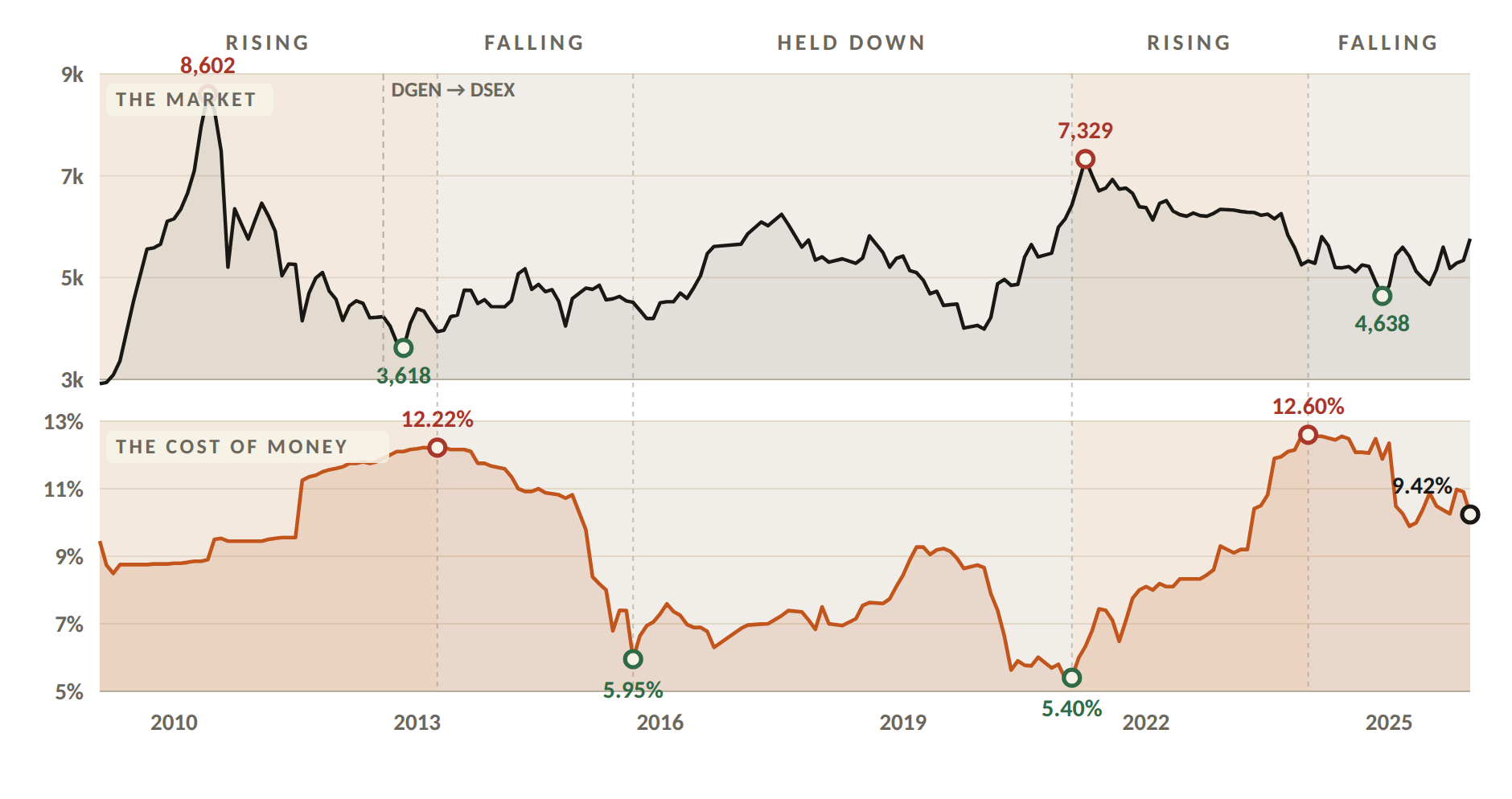
The stock index above, the 10-year bond rate below, July 2009 to June 2026. The shading marks the rate cycle — the same bands run through both panels, so you can read straight down.
Tap the chart to open it full size.
Sources: Dhaka Stock Exchange; Bangladesh Bank treasury auction results. The index is DGEN up to 28 January 2013 and DSEX after.
Why the turns are hard to spot at the time
What the central bank says and what the market charges often point in opposite directions. Bangladesh Bank switches between direct controls — how much cash banks must hold, how much they must keep in government securities, the 9 percent lending cap — and market tools like lending to banks overnight or issuing bonds. When it uses direct controls, policy can look tight while market rates fall, or loose while they rise. Both readings are true; they measure different things.
And the turns arrive late. The cheap money of 2009 and 2010 was not reversed until 2012 and 2013, by which time people had borrowed heavily and been ruined. The lending cap held rates artificially low until late 2023, so the tightening that belonged in 2022 arrived all at once in 2024.
The cost of borrowing is the thing everything else responds to.
Not a forecast about share prices. An observation about the one variable that has moved on a rhythm for twenty years — and turned two years ago.
Sources: Bangladesh Bank treasury auction results and government securities yields; Dhaka Stock Exchange. Index series: DGEN before 28 January 2013, DSEX after. General market commentary, not investment advice. What happened before is not a promise about what happens next. Ekush Wealth Management Limited is licensed by the Bangladesh Securities and Exchange Commission.