
Bangladesh markets · Part 2 of 3
From the April 2013 low to today: one recovery built on real company profits, one built on something else, two banking scandals, a war, and a banking system finally forced to admit what it had lost. Most of the damage has now been counted. Very little of it has been paid for.
This is Part 2 of a three-part series. Part 1 covers the 1996 and 2010 crashes and why only one of them ended.
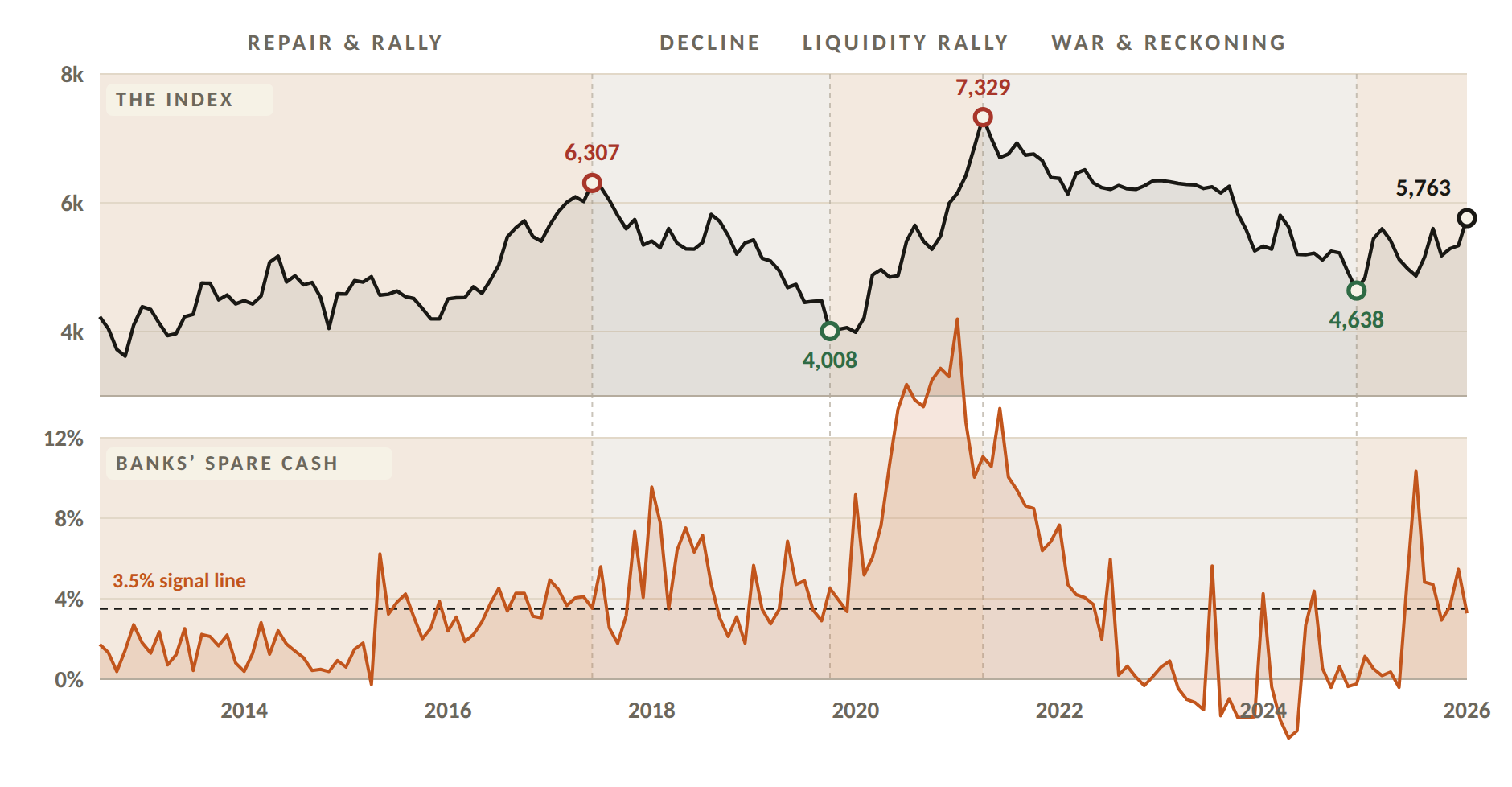
Month-end index above. Below it, the cash banks held at the central bank beyond what the rules required (excess reserve), as a share of all the money the central bank had created.
Tap the chart to open it full size.
Sources: Dhaka Stock Exchange; Bangladesh Bank. Above the 3.5 percent line, the index has usually risen over the following three to twelve months.
Two recoveries, paid for by different money
From 2013 interest rates in Bangladesh finally rose above inflation, which steadied the taka after it had fallen sharply through the 2011–12 crisis. Commodity prices were falling worldwide, so the country’s import bill shrank and its foreign currency savings rebuilt. Cash piled up in the banking system.
The 2013 taper tantrum — when the US central bank hinted it would stop pumping money into markets — pulled foreign money out of small markets everywhere, and some left here in 2014 and 2015. But a market with few foreign investors left has little to lose when foreign investors retreat.
The first recovery was real company profits
Global funds were putting money into frontier markets (the smallest and least developed stock markets), and Bangladesh was on their list. What they bought was the safest names: food, medicine and multinationals. They did this for two reasons that fed each other. After a crash, money goes to companies least likely to disappear. And the previous decade of money creation had genuinely made more Bangladeshis able to buy things.
Both halves of company profit were improving at once. These companies were selling more units, because more people were buying packaged food, medicine and branded goods. And each unit was making more money, because they had raised prices during the 2011–12 inflation and then their costs collapsed. Oil fell from $98.94 a barrel in 2014 to $44.04 by 2016 — down 55 percent — and cotton, packaging and shipping fell with it.
The currency held steady while this happened: 77.63 taka to the dollar in 2014, 80.60 by 2017 — barely 4 percent over four years. Inflation fell from 7.35 to 5.44 percent.
Selling more units, at prices already raised, against costs that were falling, in a currency that was not moving. That is close to the best conditions a company can have. The index climbed from 3,618 in April 2013 to 5,036 by December 2016 — up 39 percent over three and a half years, which is the pace of a market being repriced on real earnings.
The second recovery was cheap money, and a fight over who owned the banks
The spare cash banks kept at the central bank, which had averaged just 1.74 percent of created money during the drought of 2010–2013, was running at 3.54 percent through 2016 and 2017. The system had money again. It went into bank shares, and the index rose 25 percent in eleven months to 6,307 by November 2017.
But the buying in bank shares had nothing to do with bank profits. Through 2017 and 2018, control of several banks changed hands in contested takeovers backed by the government of the time — most visibly Islami Bank Bangladesh, until then associated with Jamaat-e-Islami, and Social Islami Bank. The buyer in the most prominent cases was S Alam Group. To get a seat on a bank’s board you must own its shares, and someone buying shares to win control of a bank does not care much what price they pay.
Scandals, decline, and a price floor
The banks that changed hands did not become better banks. Lending to connected parties grew, oversight weakened, and bad loans started climbing again. The P K Halder scandal at Padma Bank, formerly Farmers Bank, made the rot impossible to ignore.
And the foreign investors who had led the 2013–2016 recovery started leaving. The US–China trade war from 2018 was the trigger: as global funds rethought their small-market holdings, Bangladesh was a minor line in portfolios being simplified. What began as rebalancing became an exit, and every later shock gave it another reason to continue — COVID and the closure of the exchange, then the floor price that made shares impossible to sell at any price, then the Russia–Ukraine war and a currency moving against them.
A foreign investor who cannot sell at a real price does not wait. They mark the market as un-investable and take it off the list.
−Tk 4,512cr
Net foreign selling across 2021 and 2022 — 91 percent of the entire five-year outflow, packed into two years.
Then it stopped. Net foreign flow was positive Tk 64 crore in 2023, and what left after that was small: minus Tk 262 crore in 2024 and minus Tk 270 crore in 2025, roughly a tenth of the 2021 pace. Foreign buying recovered too, from Tk 1,116 crore in 2023 to Tk 1,825 crore in 2025.
On those annual numbers, the seller looked finished. The monthly ownership records say otherwise — and they are worth looking at in full.
Two policies that held the market down
COVID pushed the index to 4,008 in March 2020 and closed the exchange for two months. Two decisions shaped everything that followed: the regulator set minimum prices below which shares could not trade (the floor price), and Bangladesh Bank capped lending rates at 9 percent from April 2020, a cap that stayed until late 2023. Both were presented as protection. Both stopped prices from telling the truth, and both distorted bank profits for years.
Another large dose of cheap money followed, and another rally: up 83 percent to 7,329 by September 2021. It is worth noticing what that peak actually was. 7,329 was still 15 percent below the 2010 high. Not a record — a lower high inside a decline that had not finished.
War, currency, and the reckoning
The Russia–Ukraine war from February 2022 sent energy and food prices up and exposed everything the cap and the floor had been hiding. The US central bank raised its rate from near zero to over 5 percent between 2022 and 2024, the fastest tightening in forty years, which pulled money out of small markets worldwide. Bangladesh’s foreign currency savings fell from $48.1 billion in August 2021 to $18.6 billion by November 2024. The country entered an IMF programme worth about $4.7 billion in January 2023.
Then in mid-2024 the government changed, and the banking system was re-examined. Bad loans went from 11.11 percent in March 2024 to 35.73 percent by September 2025. A jump that size in eighteen months is not new borrowers defaulting — it is old losses finally being admitted. Five banks were merged in 2026, and Bangladesh Bank has handed over Tk 75,900 crore in emergency support to banks in trouble.
The market bottomed at 4,638 in May 2025.
What the ownership records actually show
Figures for foreign buying and selling are published only in pieces. But how much of each company foreigners own is published every month, and that is a cleaner record: a single large trade cannot hide it, and it goes back to 2018 without gaps.
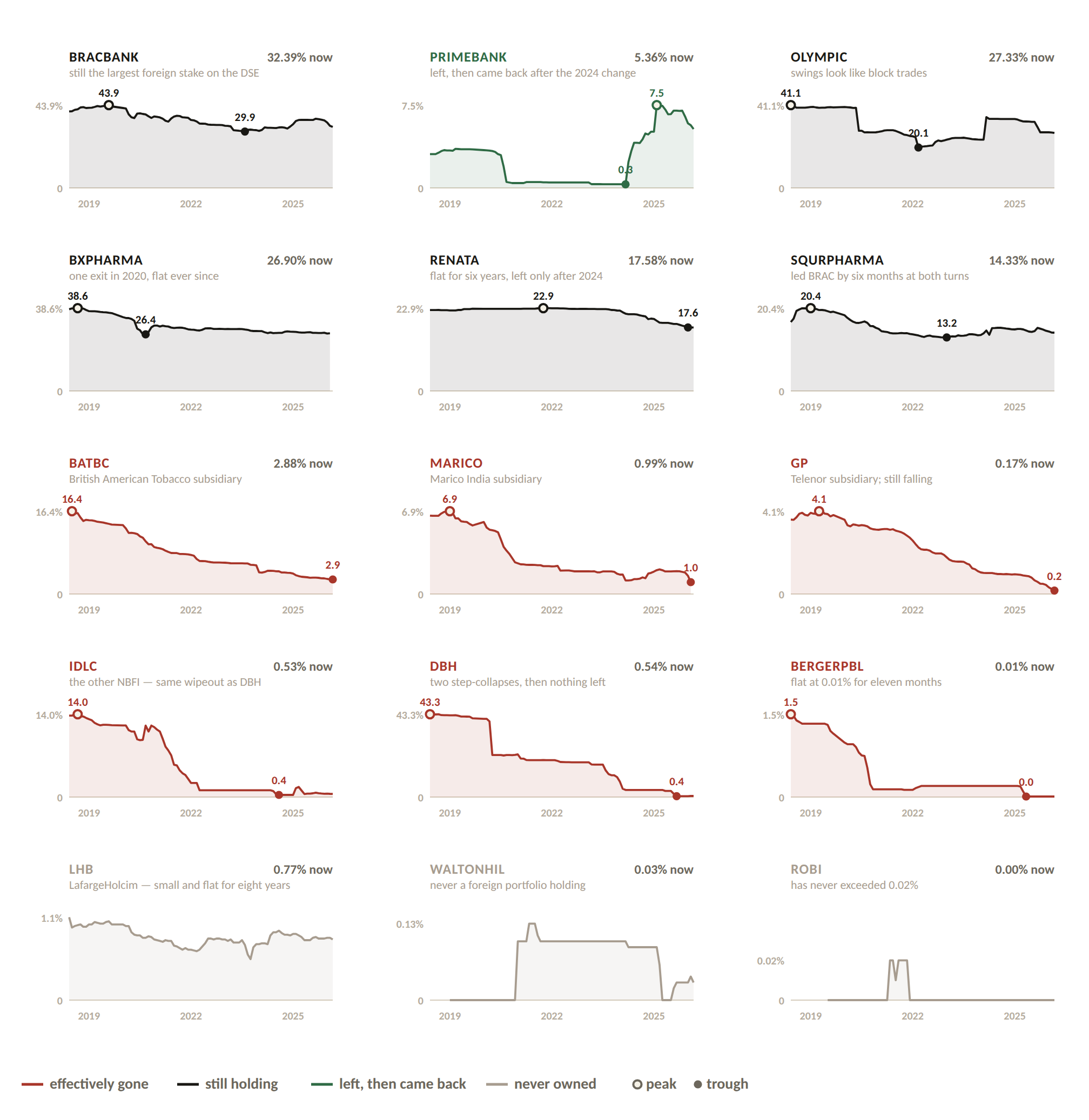
Fifteen DSE companies, monthly, from November 2018 to August 2026. What it shows is not one exit but four different outcomes.
Percent of each company’s shares held by foreign investors. Each panel has its own scale — compare the shape, not the height.
Tap the chart to open it full size.
Source: LankaBangla Financial Portal, monthly shareholding position.
Four companies were almost completely abandoned. Berger Paints fell from 1.49 percent foreign-owned to 0.01, DBH from 43.29 to 0.54, IDLC from 14.03 to 0.53, Grameenphone from 4.06 to 0.17. Marico and British American Tobacco are close behind, down 86 and 82 percent.
Three were never foreign holdings at all. Robi has never gone above 0.02 percent, Walton peaked at 0.13, LafargeHolcim has sat between 0.5 and 1.05 for eight years. Their flat lines are not an exit — nobody was ever there.
Five kept their investors. BRAC Bank, Beximco Pharma, Olympic, Square Pharma and Renata all sit between 66 and 85 percent of their 2018 level. And one came back.
The exit was not the same everywhere — it was by sector
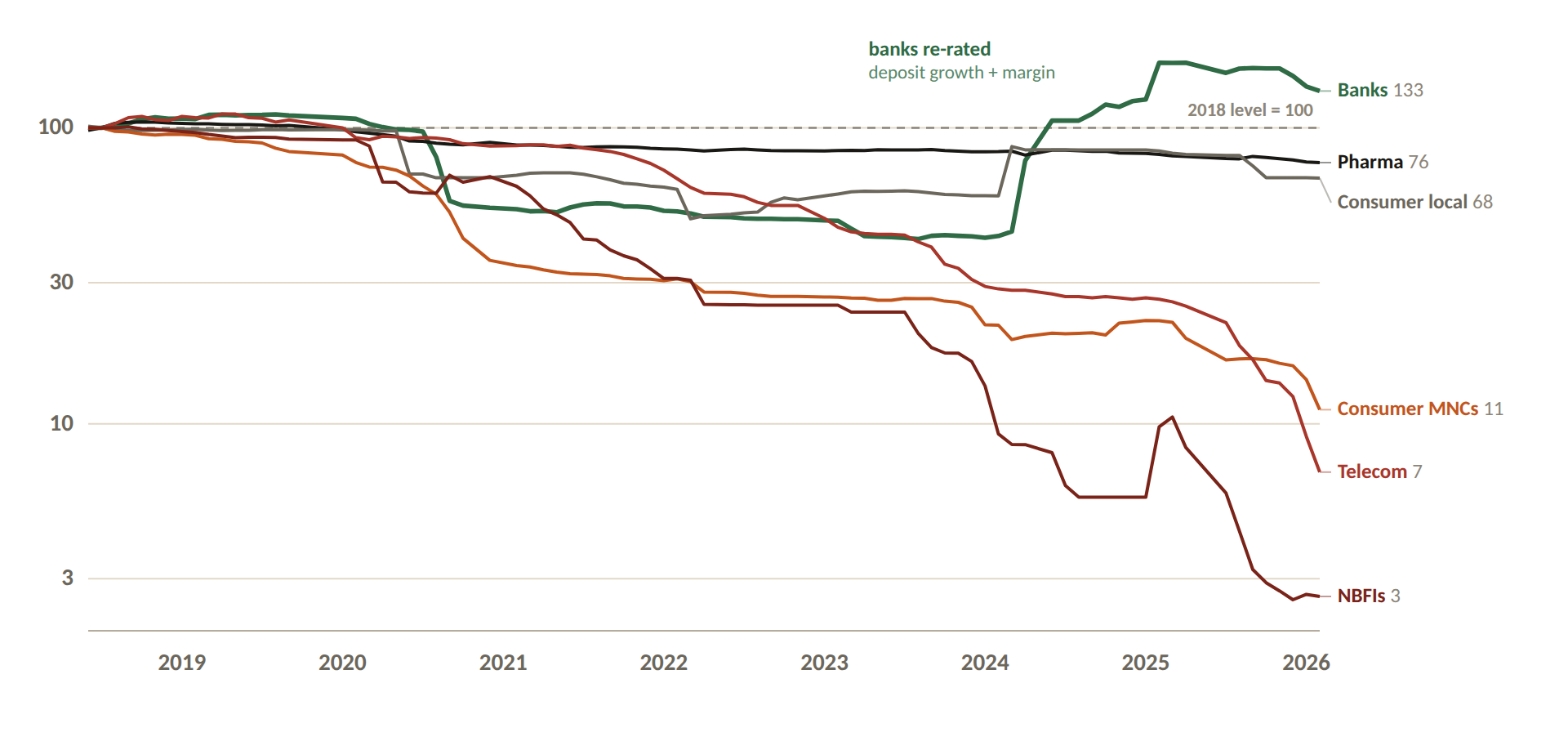
Average of the companies in each sector, all set to 100 in December 2018. The scale is logarithmic, so equal vertical distances are equal percentage changes.
Tap the chart to open it full size.
Banks (BRAC, Prime) · Non-bank lenders (DBH, IDLC) · Pharma (Square, Beximco, Renata) · Consumer multinationals (BATBC, Marico, Berger) · Consumer local (Olympic) · Telecom (GP).
Read by sector, the picture becomes clear. Non-bank lenders are a wipeout — an index of 3, meaning 97 percent of the foreign money is gone. Telecom is at 7. The consumer multinationals are at 11. Pharma held up best at 76, and local consumer at 68.
And then there are the banks, at 133 — above their 2018 level, and the only sector where foreign money is now larger than before any of this started.
For the survivors that produced growth on two fronts at once: deposits moved towards the strong banks, so they had more to lend; and with the cap gone, the gap between what they charged borrowers and paid depositors widened. More business at a better margin is the same combination that drove the consumer rerating of 2014 to 2017 — and it is rare enough that foreign money noticed.
You can see it in the two bank panels. BRAC Bank bottomed at 29.90 percent foreign-owned in January 2024 and was bought back up to 36.72 by February 2026. Prime Bank is the sharper case: foreign ownership had fallen to 0.33 percent by the end of 2023 — effectively nobody — then rose to a record 7.54 percent by July 2025. That is not drift. Somebody made a decision.
But the buying stopped in February 2026, when a new war began
On 28 February 2026, the United States and Israel began striking Iran. Iran closed the Strait of Hormuz — the narrow sea passage through which roughly a fifth of the world’s oil travels — and oil and shipping costs jumped. For a country that imports nearly all of its fuel, that is a direct hit: costlier imports, renewed inflation, and a threat to the falling-inflation conditions that had been lifting both shares and bonds since May 2025.
The foreign ownership panel turned that same month. Since February 2026, foreign ownership has fallen in nine of the eleven companies that had any to lose. BRAC Bank is down 4.33 percentage points, Olympic 2.93, Prime Bank 1.68. Only Beximco Pharma is flat. June and July are the two sharpest months in nearly every name.
The bank rerating was real, and it is now being unwound. Whether that is investors taking profit on a trade that worked, or a war-driven retreat that becomes another long exit, is the open question — and the monthly records will answer it before any annual table does.
45%
Of the average foreign stake across eleven companies, gone since December 2018 — from 21.31 percent to 11.79.
Where the repair actually stands
Foreign currency savings are back to $31.6 billion, up 70 percent from the low. Bad loans have turned, 35.73 down to 32.26 percent. The central bank has cut its rate for the first time in this cycle. Foreign selling of the kind seen in 2021 has stopped. External debt to GDP, at 24.3 percent, is lighter than the 30 to 34 percent of the 1996 crisis. Daily trading is up 70.8 percent on a year ago, and the taka has moved less than 1 percent in twelve months.
Against that: exports grew 0.17 percent in the year to June 2026, and shares trade at 9.40 times company earnings — cheap next to the region, but a long way from the 6 times reached at the 2003 bottom.
Most of the damage has been counted. Very little of it has been paid for.
Part 3 steps back from events to the one thing that has moved on a steady rhythm for twenty years — the cost of borrowing money, and what it is doing now.
Sources: Dhaka Stock Exchange; Bangladesh Bank (money supply, bank reserves, bad loans, foreign currency reserves); LankaBangla Financial Portal; IMF. General market commentary, not investment advice. What happened before is not a promise about what happens next. Ekush Wealth Management Limited is licensed by the Bangladesh Securities and Exchange Commission.